In a lithium-ion cell, Li⁺ ions move through a carbonate electrolyte between electrodes. Continuum models give conductivity. Molecular dynamics shows whether a given Li⁺ is coordinated by carbonyl oxygens, paired with PF₆⁻, or sitting in a dense layer at a wall.
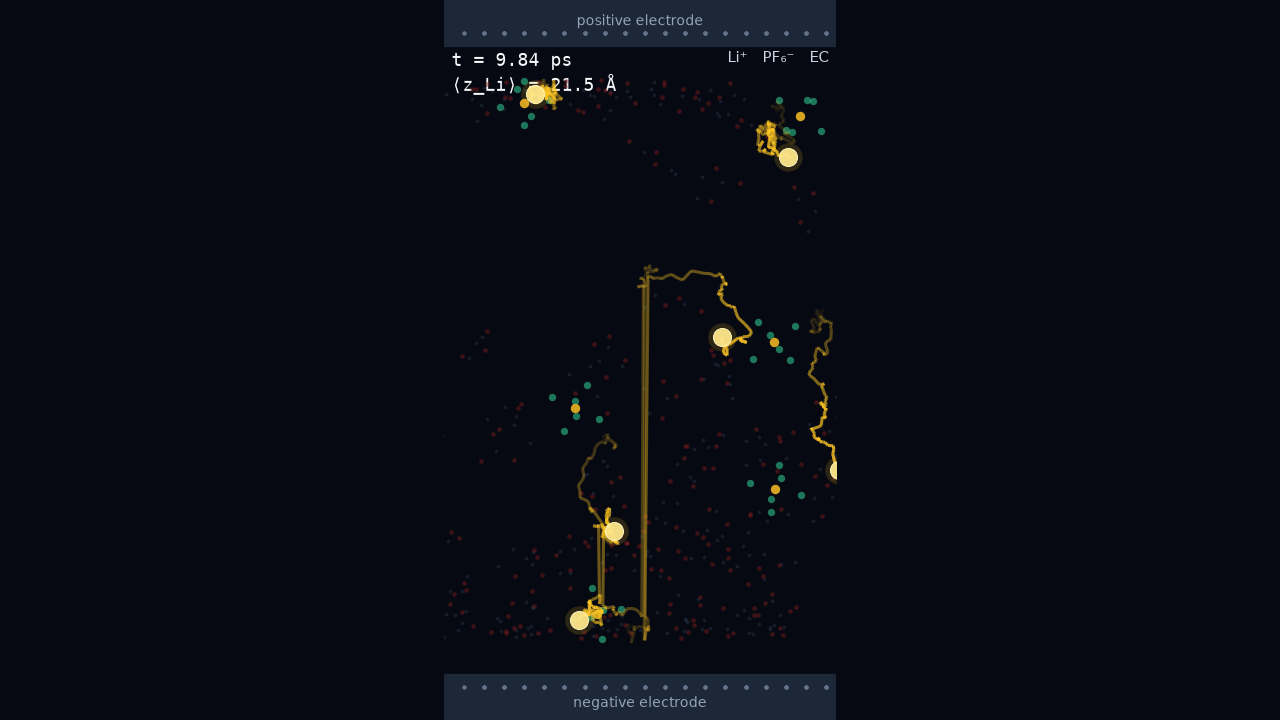
Background
Working cells dissolve LiPF₆ in cyclic and linear carbonates, typically ethylene carbonate (EC) plus dimethyl carbonate, and shuttle Li⁺ between a graphite anode and an oxide cathode. Xu, Chem. Rev. (2014) reviews that liquid. Soetens, Millot, and Maigret simulated EC/DMC + Li⁺ in 1998. Borodin and Smith built polarizable force fields for bulk transport. Tenney and Cygan (2013) classified Li–solvent clusters in LAMMPS. Boyer, Vilčiauskas, and Hwang (2016) put the electrolyte against a graphite edge.
Methods
An educational-scale cell (liquid-density EC, ~1 M LiPF₆, two graphite-like walls) was submitted from app.quickmdsim.com and run with LAMMPS in a cloud container.
atom_style fullfor bonds and angles (EC and octahedral PF₆⁻)pair_style lj/cut/coul/longandkspace_style pppmwith a slab correction for non-periodic z wallsfix efieldon the mobile group after 2 ps NVT equilibration- Project files:
input.lammpsanddata.lammps
Li⁺ Lennard-Jones from Åqvist (1990). PF₆⁻ from Canongia Lopes and Pádua (2004). EC charges after Soetens et al. (1998), with OPLS-AA Lennard-Jones and harmonic springs on a 6-site united-atom ring (no explicit hydrogens; the image is not built with SHAKE).
The applied field is larger than in a working cell so that drift is visible
in 10 ps. At experimental fields the same displacement would take
nanoseconds. The movie is rendered from
dump.electrolyte.lammpstrj.
What the dump shows
- Mean Li⁺ z falls from 25.1 Å to 21.5 Å after the field turns on (drift toward the negative electrode).
- Each Li⁺ keeps a first-shell oxygen coordination of about 3–4 (carbonyl and ether oxygens of EC within 2.8 Å).
- PF₆⁻ remains octahedral. Some Li⁺ share an anion (contact ion pairs of the kind Tenney and Cygan counted in bulk).
Product notes
Electrolytes need a read_data file with atom types, charges,
bonds, and angles. QuickMDSim copies that file into the working directory
with the input. Long-range Coulomb (PPPM) and bonded molecule styles are
compiled in. A slab correction (kspace_modify slab 3.0) allows
walls on boundary p p f.
Files
Repo path demos/li-ion-electrolyte/.
Regenerate data with python3 scripts/gen_li_ion_electrolyte.py.
The app starter is named Li-ion electrolyte.
- Open app.quickmdsim.com
- Pick Li-ion electrolyte (or upload the two demo files)
- Run
- Watch
movie.mp4, then colordump.electrolyte.lammpstrjby type in OVITO. Li is type 1.
Educational cell, sized for the free tier. Cite Xu (2014) for the electrolyte; Åqvist, Lopes and Pádua, Soetens, and OPLS-AA for the numbers; Tenney and Cygan and Boyer et al. for what to measure in the dump.